








13 employee benefits platform providers to consider in 2027
Compare 13 employee benefits platform providers for 2027. See strengths, drawbacks, pricing and how to choose for your plan year.
In this piece
Quick answer: The leading employee benefits platform providers for 2027 are Forma, Workday, Oracle Cloud HCM, Dayforce, UKG, Paycom, Alight, Deel, BambooHR, TriNet, Rippling, Gusto, and ADP Workforce Now.
Open enrollment season exposes every weak point in a benefits program: carrier files that need manual fixes, employees who cannot find their plan documents, and a renewal that arrived with another increase attached. If your benefits team spends more time reconciling vendors than designing programs, the platform underneath is usually the reason.
The pressure is only growing for 2027. Health benefit costs are climbing at the fastest pace in over a decade, employees expect more choice in how their benefit dollars get used, and more companies run programs across several countries at once. A platform that handled 2024 well may not be built for any of that.
The 13 employee benefits platforms below range from enterprise HCM suites to flexible benefits platforms and global payroll systems. Each entry covers what the provider does well, its pros and cons, and which employers it fits, so you can shortlist with confidence before 2027 plan year decisions are locked.
Key takeaways
- Employee benefits platform providers fall into five groups: all-in-one HCM suites, benefits administration specialists, flexible benefits platforms, global payroll or EOR systems, and SMB-focused HR platforms.
- Rising costs are driving vendor changes: 90% of U.S. employers cite benefit costs as the top issue shaping strategy, and 73% plan to switch to better-value vendors, according to WTW.
- Only 57% of employees fully understand what their benefits cover, so employee experience and decision support belong on every evaluation scorecard alongside integrations and reporting.
- The right choice depends on your account structures, global footprint, and how much budget visibility you need, not on feature count alone.
- Forma leads this list because it lets benefits teams run Lifestyle Spending Accounts, HSAs, FSAs, HRAs, and recognition programs as purpose-built wallets inside one employee experience, across 110+ countries. Schedule a demo today to see how a connected benefits portfolio could work for your 2027 plan year.
What are employee benefits platform providers?
Employee benefits platform providers are companies that sell software to design, deliver, and administer employee benefits programs. The category spans everything from enrollment and carrier connections to spending accounts, compliance reporting, and the employee-facing portal or app.
Most providers started in one corner of that space and expanded outward. Payroll companies added benefits administration, HCM suites added decision support, and flexible benefits platforms built spending accounts alongside core coverage. A provider's roots usually tell you what it does best.
Benefits administration software vs. a flexible benefits platform
Benefits administration software handles the mechanics of core coverage: eligibility rules, open enrollment, life events, payroll deductions, and clean files to carriers. It is often bundled into the HRIS or payroll system you already run.
A flexible benefits platform solves a different problem. It lets employers fund accounts that employees direct toward the categories that matter to them, from Well-being to Professional Development, with reporting on where those dollars go. Many benefits teams run both, which is why integrations matter so much.
Types of employee benefits platforms
The 13 employee benefits providers below cover five distinct models, and the differences shape pricing, implementation effort, and who will own the system:
- All-in-one HCM suites: Workday, Oracle Cloud HCM, Dayforce, UKG, Paycom, and ADP Workforce Now manage benefits alongside payroll, time, and talent in one database.
- Benefits administration specialists: Alight focuses on enterprise benefits administration, navigation, and leave management rather than payroll.
- Flexible and personalized benefits platforms: Forma gives employees choice through configurable spending accounts and wallets that complement core coverage.
- Global payroll and EOR platforms: Deel administers benefits for employees hired across borders, including workers employed through an employer of record.
- SMB-focused HR platforms: BambooHR, TriNet HR Platform, Rippling, and Gusto bundle benefits with HR and payroll for smaller and growing employers.
13 best employee benefits platform providers at a glance
Before the detailed reviews, the table below summarizes who each provider serves best, what it administers, and how it charges. Use it to narrow the field to three or four candidates before reading further.
The 13 best employee benefits platform providers for 2027
Each provider below is active as of October 2026, and the facts reflect current products rather than 2025 marketing. Where a company changed ownership or renamed a product since this list was last published, that change is noted.
1. Forma
Forma is a flexible benefits platform built for employers that want to move beyond one broad spending account toward a connected portfolio of dedicated benefits wallets. Benefits teams configure each wallet around a specific use case, funding strategy, and workforce need, while employees get one unified experience to access all of them.
Forma supports Lifestyle Spending Accounts, pre-tax accounts including HSAs, FSAs, and commuter benefits, Health Reimbursement Arrangements, and Rewards and Recognition. Companies like Stripe and Logitech use it to run personalized programs at scale.
Features
Forma's features are built around one idea: benefits should be intentionally designed, not simply offered. The sections below cover how that plays out for account design, administration, global teams, payment, and security.
Spending accounts in one platform
Employers can run pre-tax and post-tax accounts side by side, with HSAs, FSAs, HRAs, and Lifestyle Spending Accounts administered through one platform. Each account keeps its own eligibility rules, funding, and compliance treatment, while employees see everything in a single portal and app.
Claims review is handled by Forma's team, with reimbursements and real-time balance tracking for employees. Compliance features for pre-tax accounts help benefits teams keep up with tax rules and reporting requirements, and the 2027 HSA limits are already published for planning.
Purpose-built wallets and flexible program management
Instead of forcing every need into one catch-all account, Forma lets employers configure anywhere from one to 15 or more dedicated wallets for Well-being, Family Formation, Caregiving, Professional Development, and more. The account structure behind each wallet depends on the country, covered expenses, and compliance requirements.
Benefits teams adjust categories, eligibility, and funding through click-not-code configuration rather than IT tickets. Dashboards report engagement (who is using each wallet) separately from utilization (how much of the allocated funds are spent), which is the distinction finance teams need for forecasting.
Support for global teams
Forma supports employers in 110+ countries with country-level configuration, local currency support, and cost-of-living adjustments, which is how global teams deliver geographic equity rather than geographic uniformity. Benefits teams keep centralized oversight and consolidated reporting while employees receive support that feels meaningful in their local market.
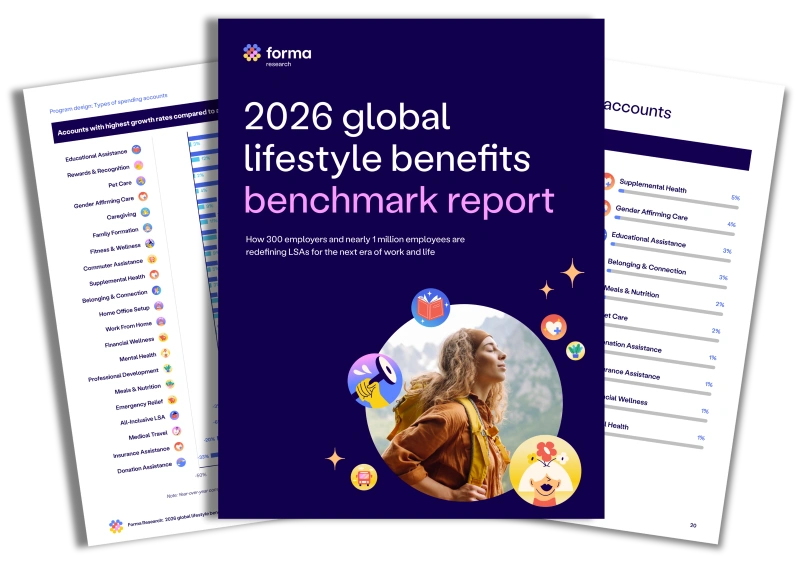
Forma's own data shows how common this has become. The company's 2026 benchmark, drawn from nearly 1 million employees at 300 companies, found that 50% of employers now run spending accounts in more than one country. You can read more statistics like this in our 2026 global lifestyle benefits benchmark report.
Multiple ways to use funds
Employees can access their benefits in the way that suits them, which removes the friction that leaves funds unused:
- Forma Store: A curated marketplace of products and services, often at discounted rates, purchased directly with account funds.
- Forma Visa Card: A card for direct purchases, with separate cards for LSA and pre-tax accounts so each follows its own rules.
- Claims reimbursement: A mobile-friendly claims process backed by Forma's member support team for purchases made elsewhere.
Availability of each option varies by account type, country, and program design, and Forma configures the mix with each employer.
Enterprise-grade security and integrations
The platform is SOC 2 Type 2 certified, GDPR compliant, and meets WCAG accessibility standards, with details on the security page. Integrations run through API connectors, SCIM provisioning, or file-based feeds to your HRIS and payroll, so eligibility and funding stay in sync without manual uploads.
Pros of Forma
- One platform for LSAs, HSAs, FSAs, HRAs, commuter benefits, and Rewards and Recognition
- Dedicated, use-case-specific wallets that align spend with workforce priorities
- Country-level configuration, local currencies, and cost-of-living adjustments across 110+ countries
- Reporting that separates engagement from utilization for cleaner budget visibility
- Fewer disconnected vendor relationships for benefits teams consolidating point solutions
- Enterprise security, accessibility, and HRIS integration standards
Cons of Forma
- Complements your HRIS and payroll rather than replacing them, so core HR records still live in another system
- Pre-tax accounts such as HSAs and FSAs apply to U.S. employees, while global programs run through LSAs and other configured accounts
- Custom pricing reflects a premium platform, so very small teams with a single benefit to administer may find a lighter tool sufficient
Forma fits best when consolidating point solutions, giving employees real choice, and keeping budget visibility across many programs all matter at once. Looking at employee benefits platforms for your 2027 plan year? Schedule a demo today and see how a connected portfolio of benefits wallets fits your workforce.
2. Workday
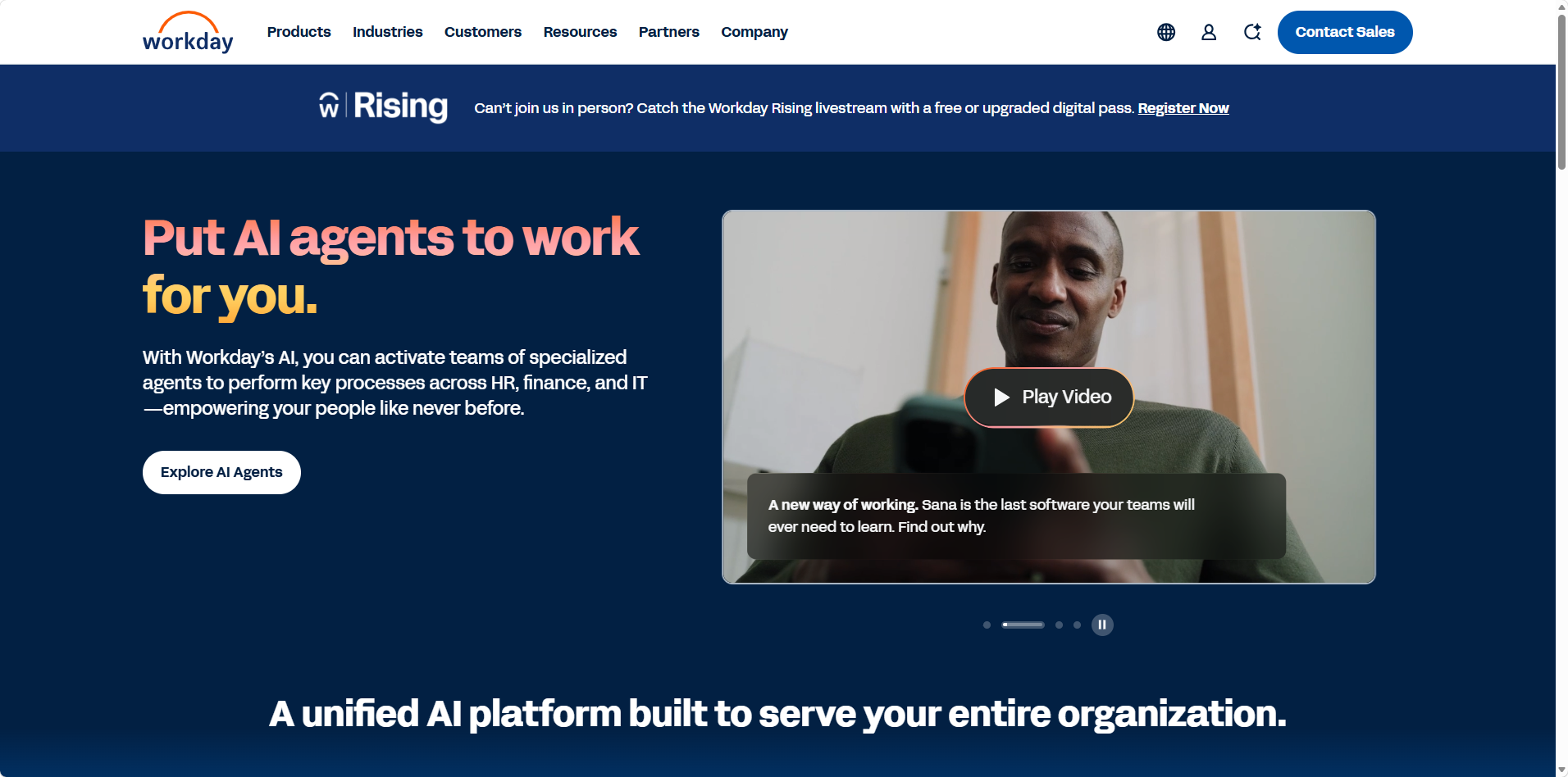
Workday is the enterprise HCM suite most large organizations evaluate first, and benefits administration sits inside its core HR database alongside payroll, talent, and workforce management. In 2026 the company is positioning the platform around AI agents and its Sana conversational interface, which extends into benefits questions and enrollment tasks.
Workday's strength is a single system of record for very large, complex organizations, and the platform holds a 4.4 rating across 46 reviews on Gartner Peer Insights in the benefits management market.
Pros of Workday
- Benefits, payroll, compensation, and talent in one system of record
- AI agents and conversational tools for employee benefits questions
- Scales to very large, multi-entity enterprises
- Deep ecosystem of third-party integrations and partners
Cons of Workday
- High total cost and long implementation cycles
- Benefits module is less configurable than dedicated spending account platforms
- Mid-sized employers often find the suite more than they need
3. Oracle Cloud HCM
Oracle Cloud HCM serves global enterprises that want HR, talent, payroll, and benefits on one data model, with embedded AI and benefits capabilities built for complex eligibility rules across many countries and legal entities.
The platform is a strong match for multinationals with 1,000 or more employees that already run Oracle for finance or ERP, where a shared data foundation reduces reconciliation work.
Pros of Oracle Cloud HCM
- One data model across HR, finance, and benefits for Oracle customers
- Handles complex global eligibility and compliance rules
- Embedded AI and strong analytics across the suite
- Built for enterprises with 1,000 or more employees
Cons of Oracle Cloud HCM
- Heavy for smaller or less complex employers
- Configuration usually requires implementation partners
- High total cost of ownership versus mid-market alternatives
4. Dayforce
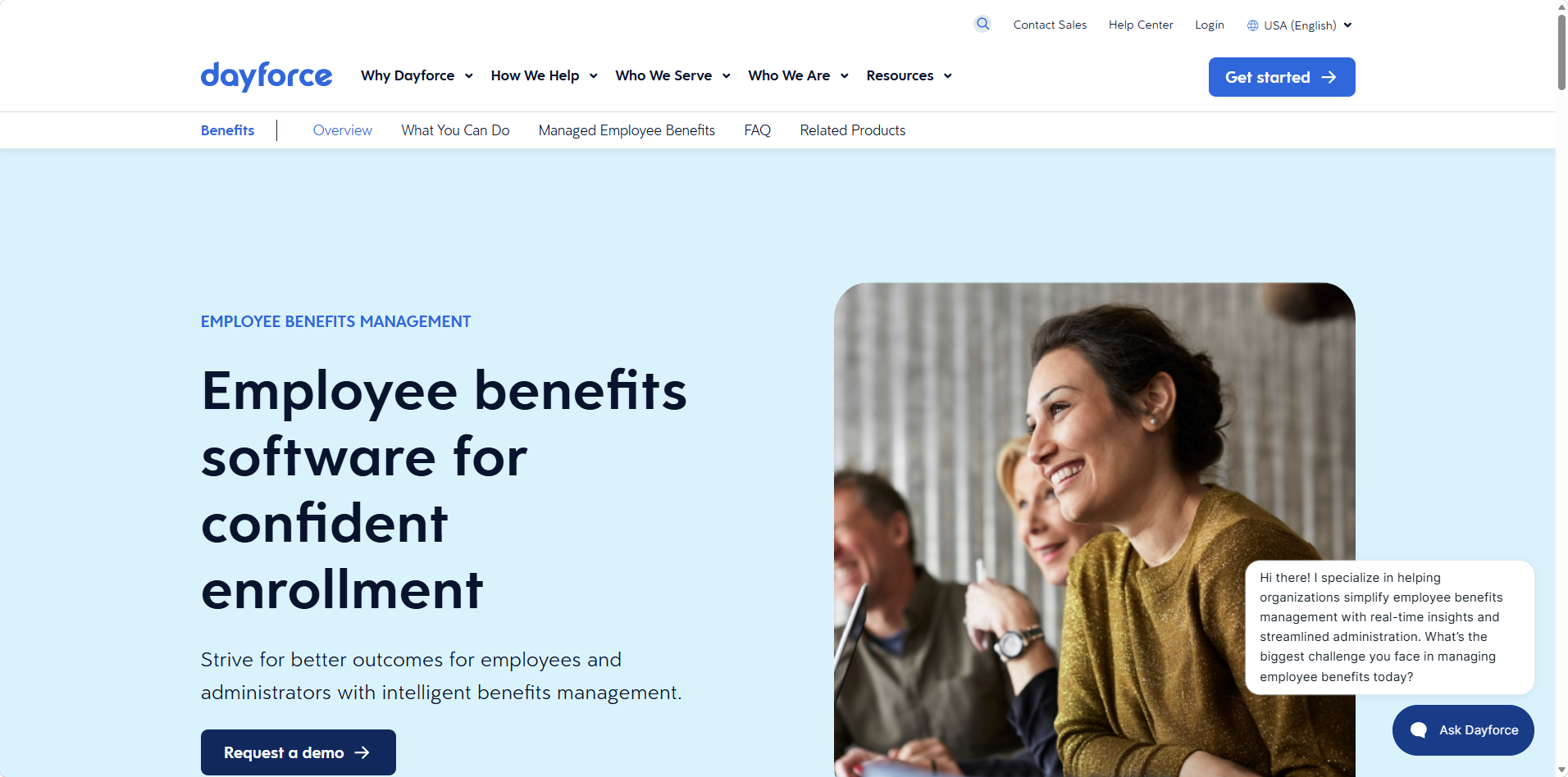
Dayforce completed its acquisition by Thoma Bravo on February 4, 2026, in a deal valued at roughly $12.3 billion, and now operates as a private company. Its benefits management is written on the same codebase as payroll, time, and talent, so enrollment changes update deductions in real time.
Dayforce stands out for decision support and planning. Guided enrollment compares plans against eligibility rules, and its Benefits Intelligence engine forecasts enrollment trends and models what-if scenarios on plan design. Employers that prefer to outsource day-to-day work can add Dayforce Managed Benefits.
Pros of Dayforce
- Real-time sync between benefits elections and payroll
- Benefits Intelligence forecasting and what-if plan modeling
- Guided enrollment with eligibility checks and plan comparisons
- Optional managed benefits services
Cons of Dayforce
- Setup is still reported as complex
- Quote-based pricing with limited transparency
- Better suited to mid-sized and large employers than small ones
5. UKG
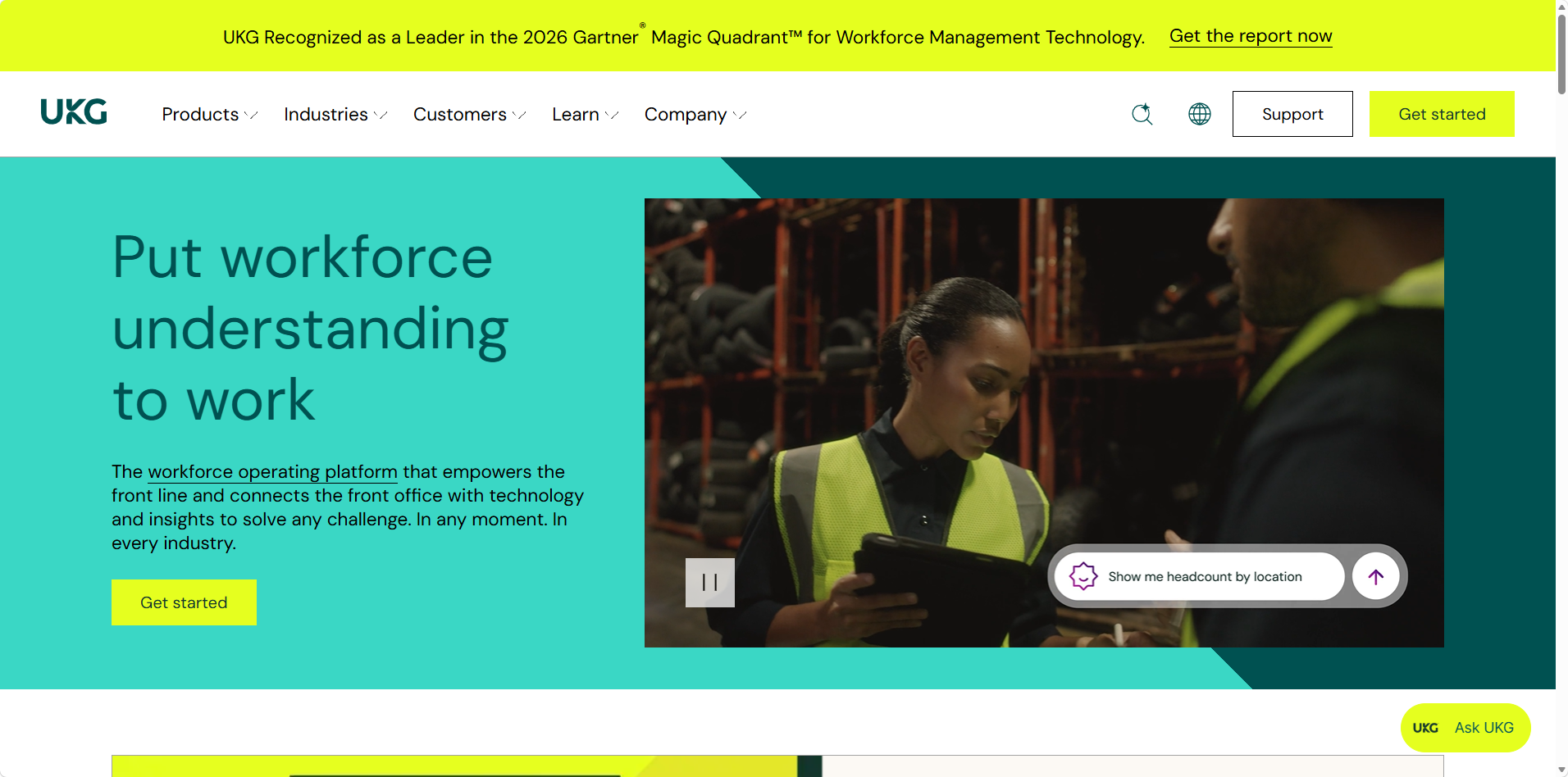
UKG offers two suites: UKG Pro for organizations with 1,000 or more employees and UKG Ready for small to mid-sized businesses. Its Benefits Hub adds side-by-side plan comparisons and a "Model My Pay" tool that shows take-home pay under different elections, and the Bryte AI assistant now sits across the suite.
UKG was named a Leader in the 2026 Gartner Magic Quadrant for both HCM and workforce management, and it is particularly strong for employers with large frontline and hourly populations.
Pros of UKG
- Benefits Hub with plan comparison and take-home pay modeling
- Strong fit for frontline and hourly workforces
- Payroll, time, and benefits on one data model
- 2026 Gartner Magic Quadrant Leader for HCM and workforce management
Cons of UKG
- Costs run high for smaller employers
- Implementation takes significant effort
- Some reviewers describe parts of the interface as dated
6. Paycom
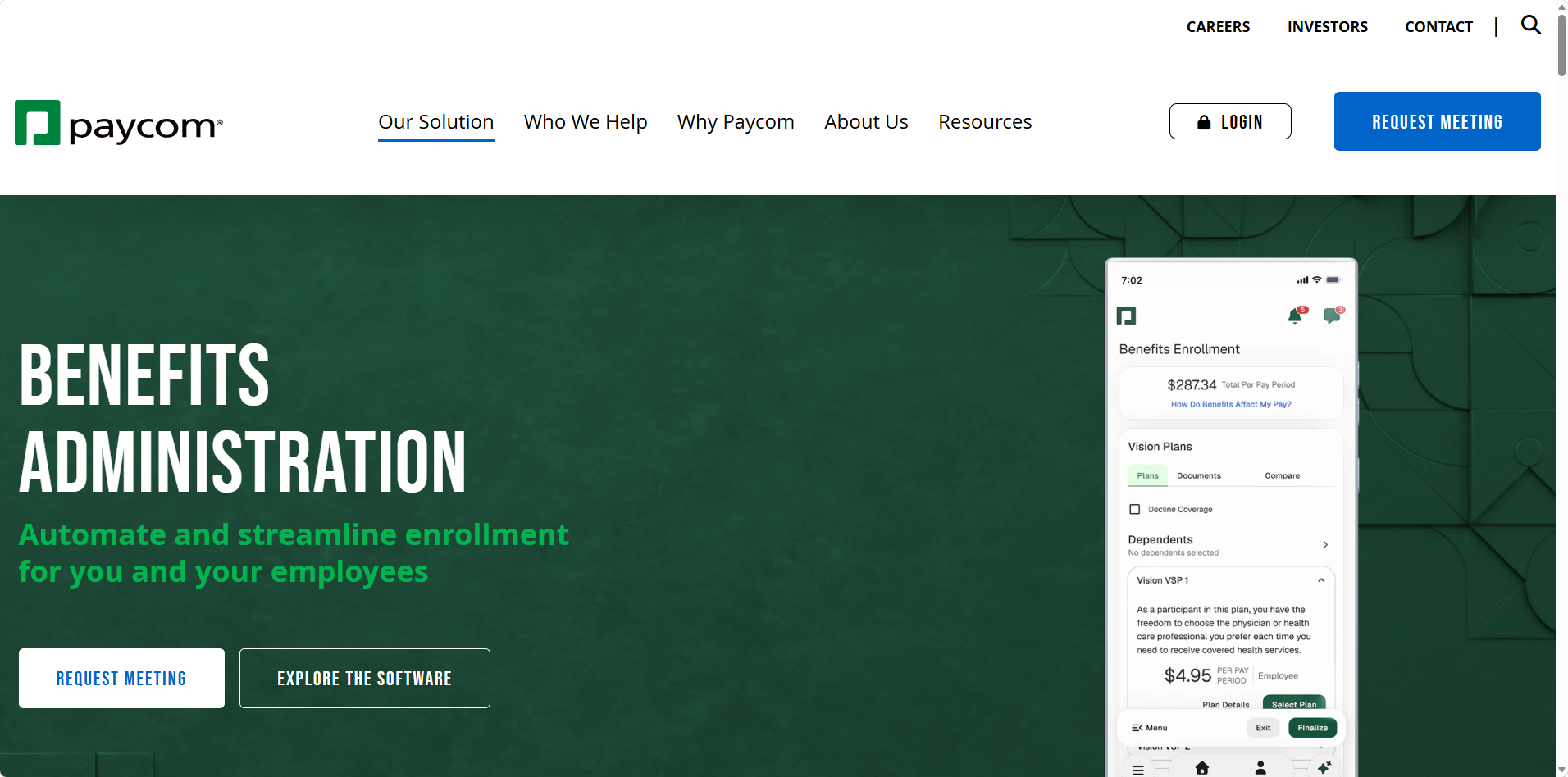
Paycom runs HR, payroll, and benefits in a single database, so benefit selections autopopulate into payroll with no re-keying. Employees see how each election changes their take-home pay before they submit, and the Benefits to Carrier tool sends enrollment data directly to providers.
Paycom's self-service model is its biggest advantage. Employees handle their own enrollment and life events, Direct Data Exchange reporting measures how much work they complete without benefits team involvement, and a Benefit Enrollment Service adds a dedicated coordinator during open enrollment.
Pros of Paycom
- Single database eliminates duplicate data entry between benefits and payroll
- Employees preview take-home pay impact before submitting elections
- Automated carrier connections through Benefits to Carrier
- Enrollment coordinator support available during open enrollment
Cons of Paycom
- U.S.-focused with limited global capability
- Works best only when Paycom also runs payroll
- Fewer third-party integrations than more open systems
7. Alight
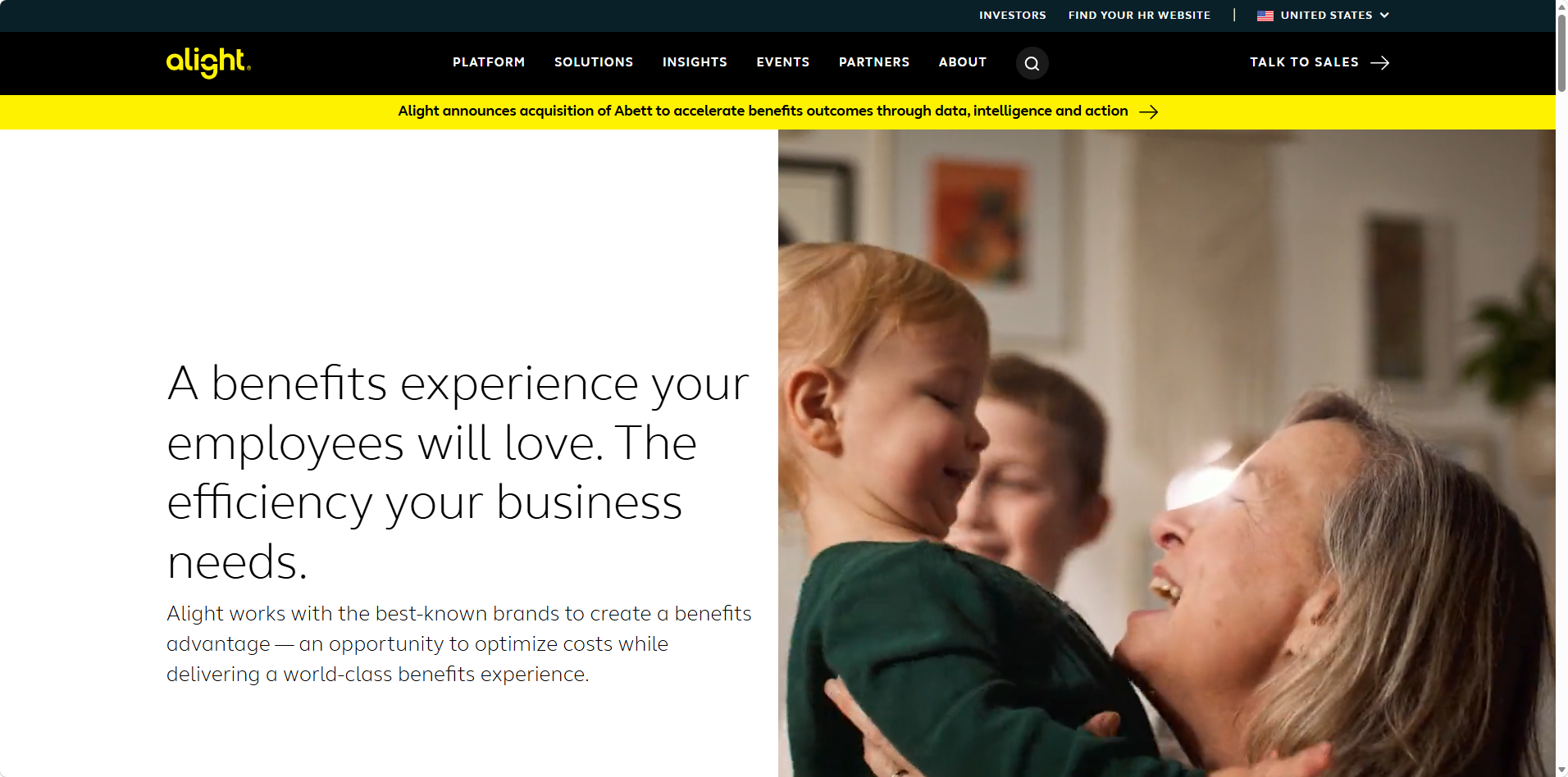
Alight sold its payroll and professional services business to H.I.G. Capital in July 2024, and that business now operates as Strada. What remains is a focused benefits platform, Alight Worklife, covering health benefits administration, retirement, leave, healthcare navigation, and digital well-being for large employers.
Alight administers benefits for more than 30 million people, connects to over 600 HR and benefits tools, and uses its LumenAI engine to personalize enrollment recommendations across web, mobile, and a virtual assistant.
Pros of Alight
- Benefits-only focus after the 2024 payroll divestiture
- Personalized enrollment guidance through LumenAI
- Health, retirement, leave, and navigation in one platform
- Open architecture with 600+ integrations
Cons of Alight
- Built for large enterprises, so custom pricing and substantial implementations
- Less relevant for employers with simpler benefits needs
- Requires integration with a separate payroll system
8. Deel
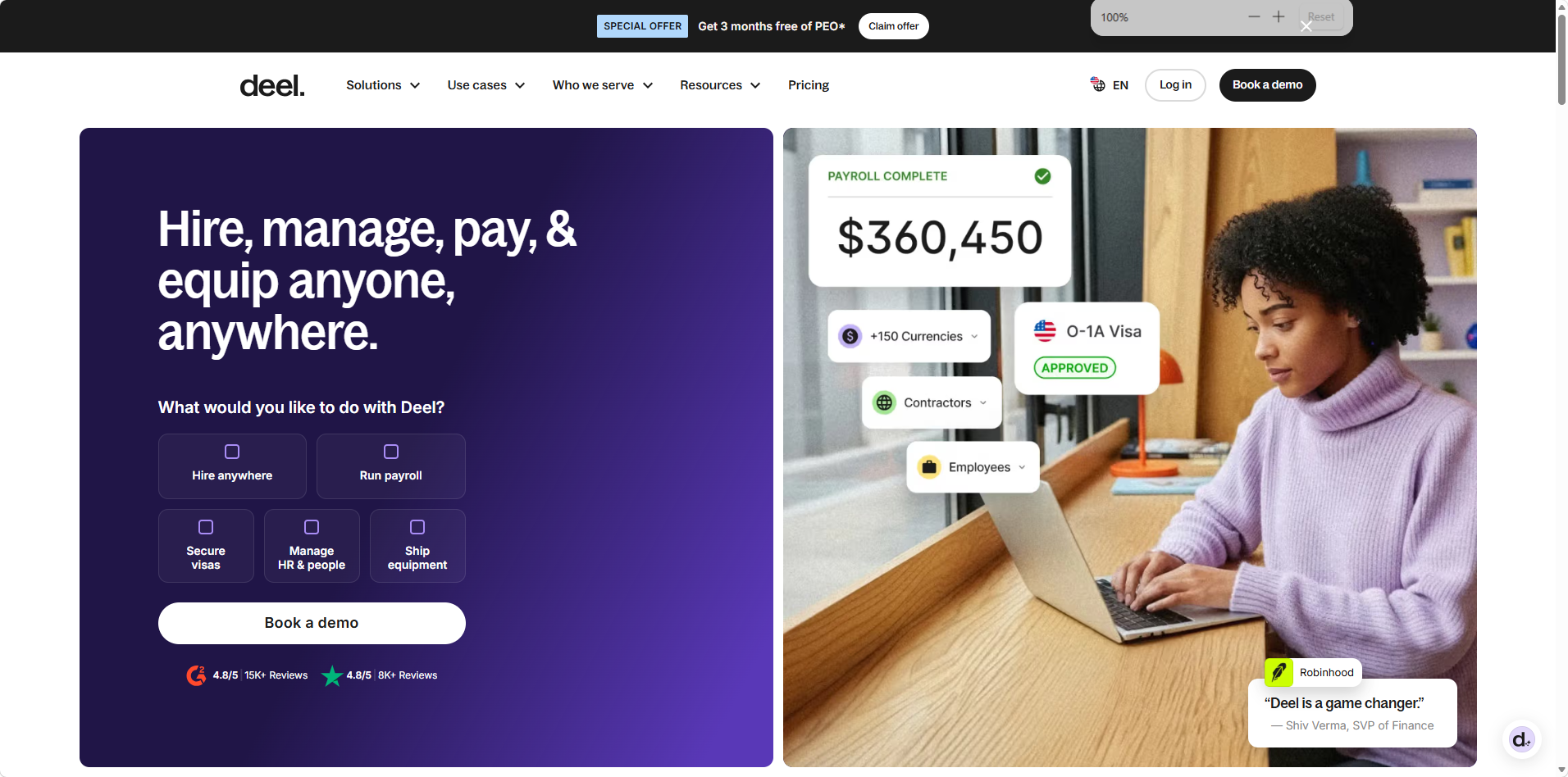
Deel is a global payroll and HR platform serving more than 40,000 customers in 150+ countries. Deel Benefits administers plans in 134 countries across more than 100 carriers, and it covers direct employees on Deel Payroll as well as workers employed through its EOR and PEO services.
For distributed teams, Deel's value is consolidation: country-specific plans, enrollment, changes, and payroll deductions all live in one place, with guidance on what is compliant and competitive in each market.
Pros of Deel
- Benefits administration in 134 countries through more than 100 carriers
- Covers direct, EOR, and PEO employees in one system
- Country-level compliance and market benchmarking guidance
- Pairs naturally with global payroll for distributed teams
Cons of Deel
- Benefits depth varies by country
- Designed around cross-border hiring, so single-country employers may find it more than they need
- Per-worker pricing scales quickly for large headcounts
9. BambooHR
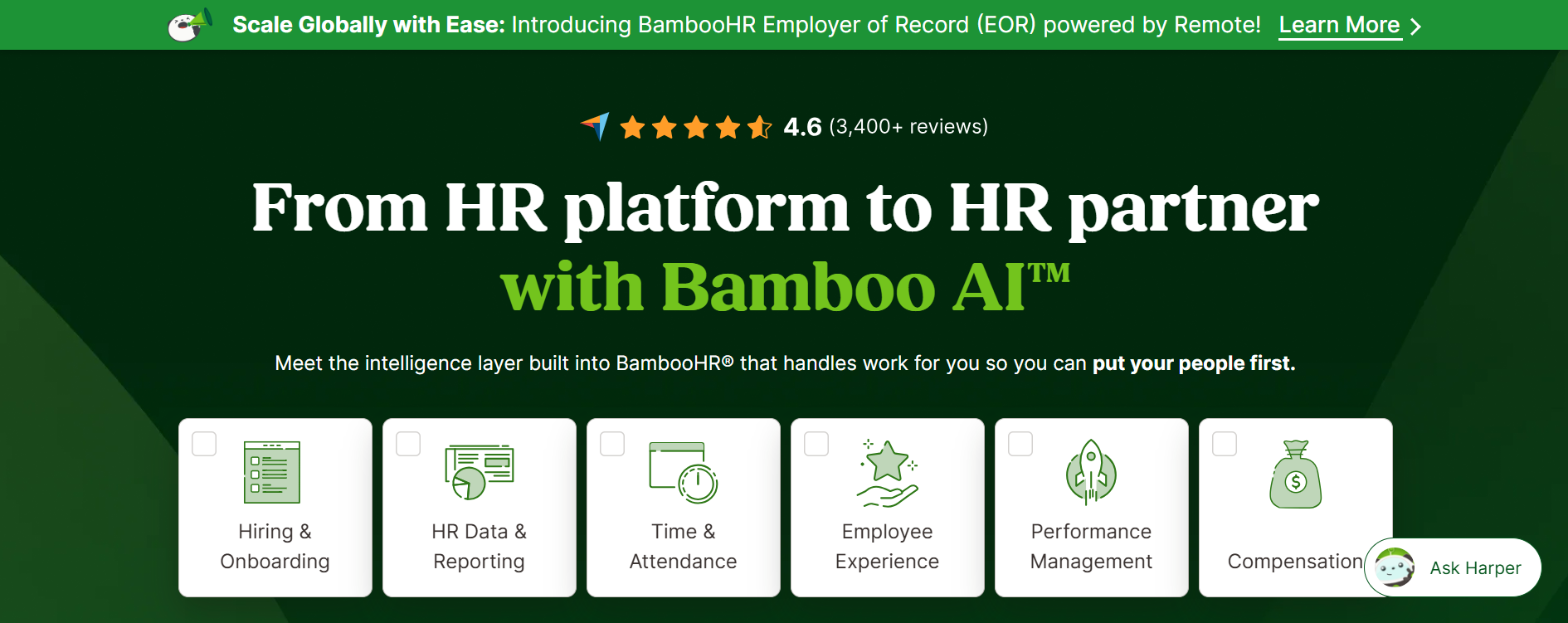
BambooHR is an HR platform for small and mid-sized businesses, and its Benefits Administration add-on brings enrollment, management, and reporting into the core system for U.S. employees. It supports medical, dental, vision, retirement, life, disability, HSA, and FSA plans.
Employees enroll directly in BambooHR or its mobile app, elections sync to payroll deductions, and automated carrier connections are available for select national carriers.
Pros of BambooHR
- Simple, well-liked interface that requires little training
- Mobile enrollment and e-signature collection
- Automated payroll deduction sync and carrier connections
- Affordable for small and mid-sized employers
Cons of BambooHR
- Benefits Administration is a paid add-on
- U.S. employees only
- Lacks the depth large or global employers require
10. TriNet HR Platform (formerly TriNet Zenefits)
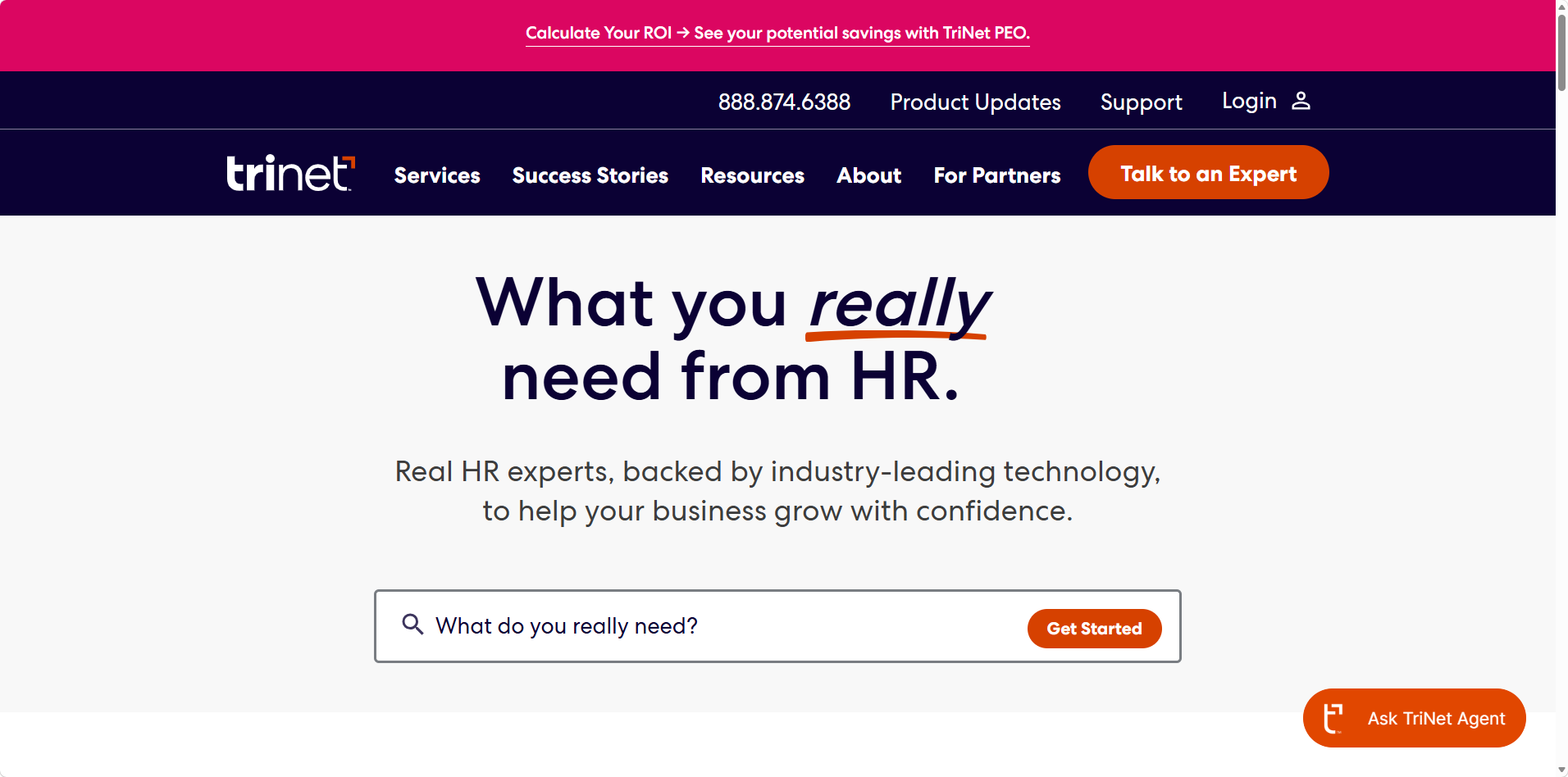
TriNet HR Platform is the current name for the product once sold as TriNet Zenefits. It serves startups and small businesses with a shared dashboard for employers, employees, and brokers, mobile enrollment, and a Health Plan Shopper tool for comparing coverage.
Pricing is published and simple. Essentials runs $10 per employee per month, Growth $20, and Zen $33 with payroll included, with discounts for annual billing and a five-employee minimum. TriNet also sells a full PEO for employers that want to outsource HR entirely.
Pros of TriNet HR Platform
- Transparent per-employee pricing with three tiers
- Shared dashboard for employers, employees, and brokers
- Health Plan Shopper tool and mobile enrollment
- Option to move to TriNet's PEO as needs change
Cons of TriNet HR Platform
- Not built for large or global employers
- Payroll is only included in the top tier
- Support quality receives mixed reviews
11. Rippling
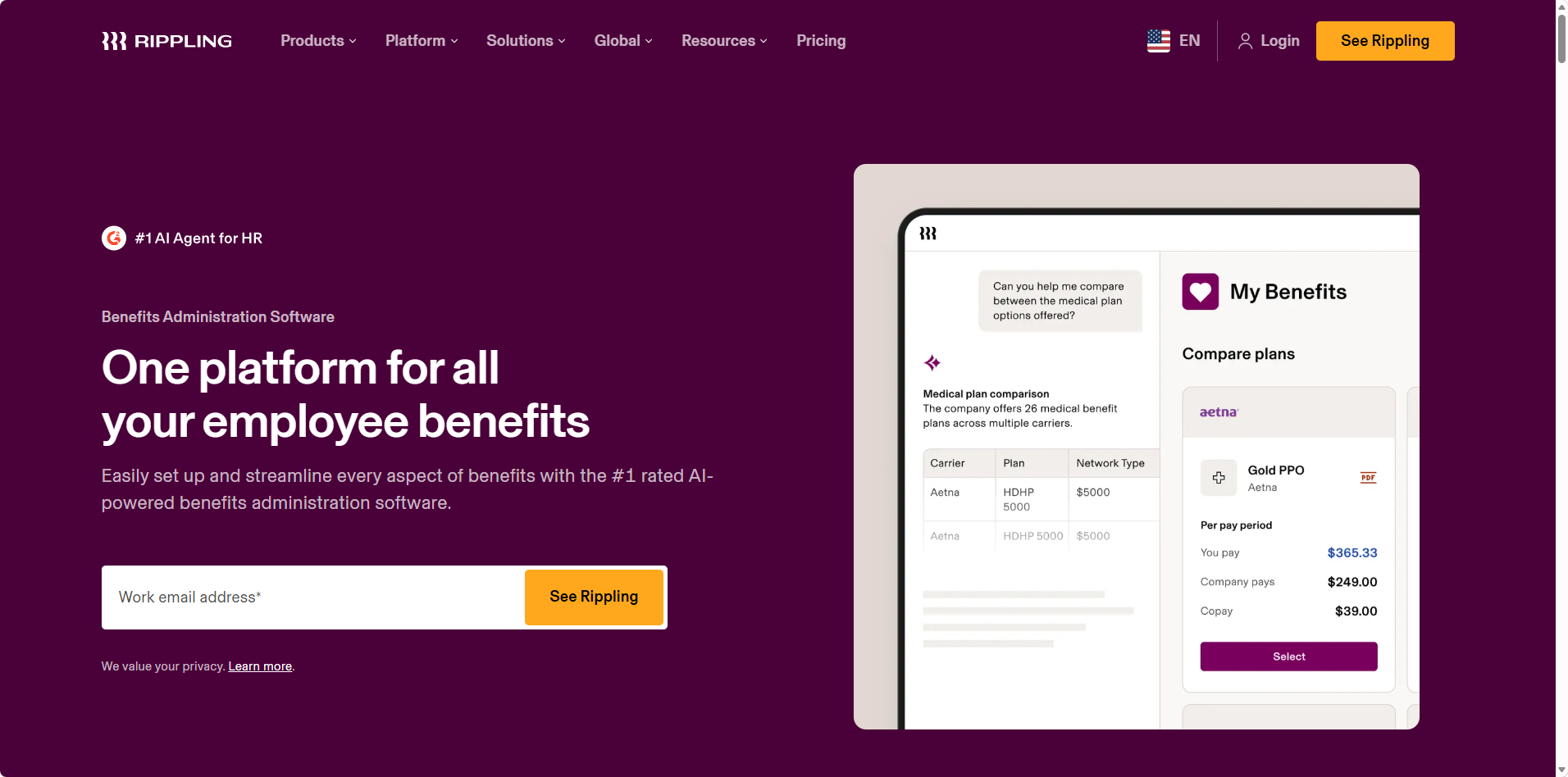
Rippling is the highest-rated vendor in Gartner Peer Insights' benefits management market, at 4.8 across 82 reviews. Its benefits administration gives access to more than 4,000 plans from carriers including Aetna, Humana, and Blue Cross Blue Shield, and employers can keep their own broker or use a Rippling referral.
New hires are enrolled automatically, life events update payroll deductions, and ACA and COBRA compliance are handled in-platform alongside FSA, HSA, and commuter benefits. Rippling also supports global teams through its EOR and global payroll products.
Pros of Rippling
- Top-rated on Gartner Peer Insights for benefits management
- 4,000+ plans with bring-your-own-broker flexibility
- Automated ACA and COBRA compliance
- HR, IT, and finance modules share one employee record
Cons of Rippling
- Modular pricing adds up quickly
- Delivers the most value only when you adopt the broader suite
- Some reviewers report slow support response
12. Gusto
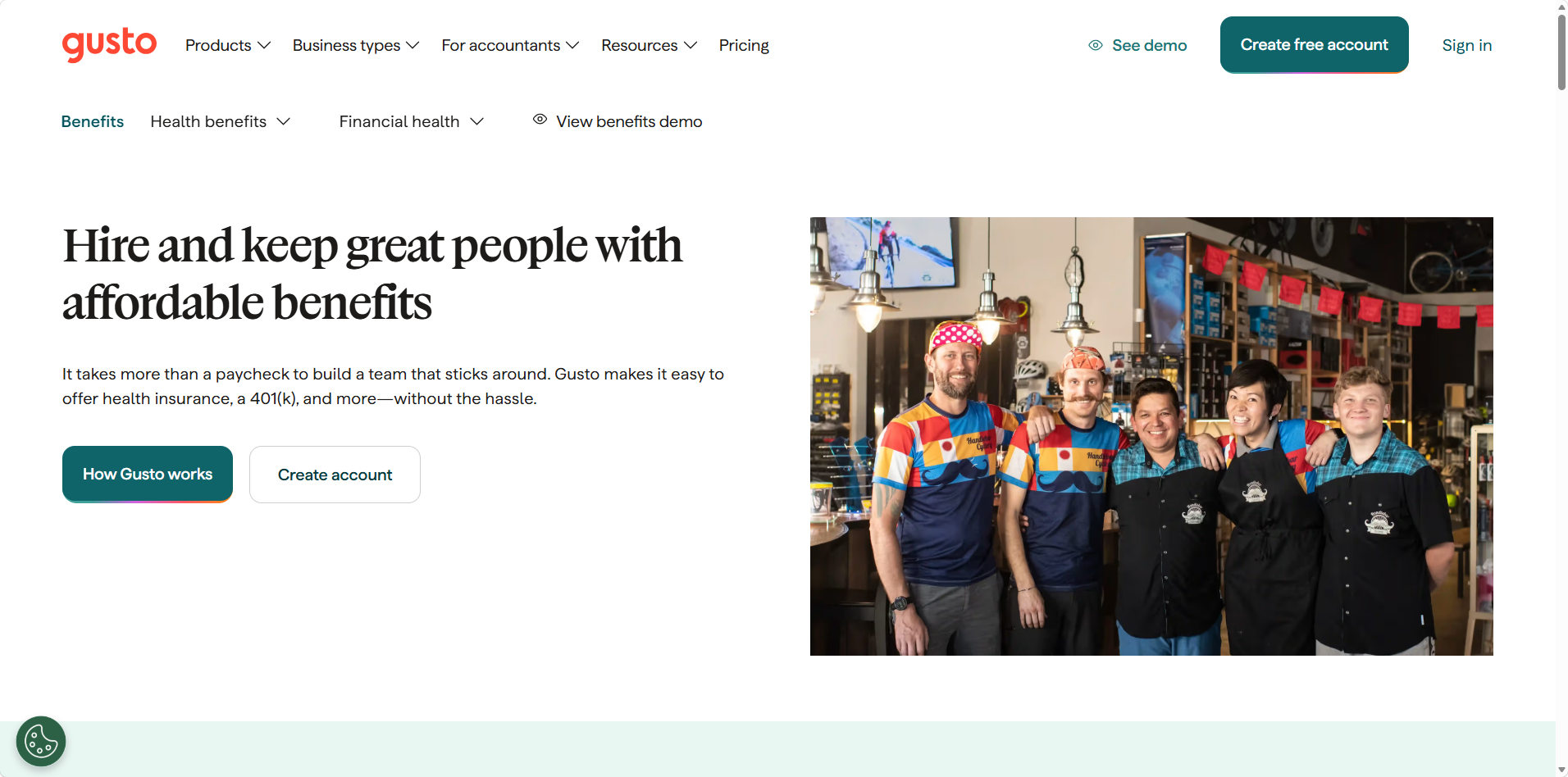
Gusto is a payroll-first platform for small businesses, offering medical, dental, and vision through more than 9,000 plans from over 30 carriers, with no broker fees. It also administers 401(k) plans, HSAs, FSAs, life and disability, and commuter benefits.
Benefits are built into every payroll run, and licensed advisors are included at no extra cost, which small teams without a benefits specialist tend to value.
Pros of Gusto
- 9,000+ health plans from 30+ carriers with no broker fees
- Benefits deductions flow automatically with each payroll run
- Licensed benefits advisors included
- 401(k), HSA, FSA, and commuter benefits in one place
Cons of Gusto
- Requires Gusto payroll
- Health plan availability varies by state
- Not designed for mid-market or enterprise needs
13. ADP Workforce Now
ADP Workforce Now is ADP's platform for mid-sized companies with 50 to 999 employees, with separate products for small businesses and enterprises. Benefits administration includes carrier connections, decision support, retirement plans, and access to the ADP Marketplace of third-party integrations.
ADP's scale is its advantage: carrier relationships, compliance support, and payroll integration are mature, and the benefits product holds a 4.1 rating across 29 Gartner Peer Insights reviews.
Pros of ADP Workforce Now
- Mature carrier connections and compliance support
- Tight integration with ADP payroll
- ADP Marketplace for third-party add-ons
- Products that span small business through enterprise
Cons of ADP Workforce Now
- Quote-based pricing with add-on fees
- Reviewers describe the interface as dated
- Implementation can take longer than newer platforms
Why benefits teams are switching employee benefits platform providers
Vendor changes used to be rare because migrations are painful. That calculus is shifting as costs climb and employees expect more from their benefits, and three forces explain why.
Cost pressure is forcing a strategy reset
Mercer's 2026 national survey projects that health benefit cost per employee will rise 8.2% in 2027, and 59% of employers plan cost-cutting changes to their health benefits. The baseline is already high: KFF puts the average family premium at $26,993 for 2025.
WTW's 2025 Benefits Trends Survey found that 90% of employers cite rising costs as the top issue shaping strategy, and 73% plan to improve value or switch to better-value vendors. A platform that cannot show where every dollar goes makes that reallocation guesswork.
Employees want choice, and most programs cannot deliver it
Aon's 2025 Global Benefits Trends Study found that 65% of employees at multinationals would trade current benefits for more choice, yet only 14% of multinationals have global guidelines in place to support personalization. Point solutions were the first attempt at choice, and point solution fatigue is what most benefits teams are now trying to fix.
The gap shows up in retention. MetLife's 2026 Employee Benefit Trends Study found that 56% of employees who intend to stay are doing so out of necessity rather than commitment, and only 18% plan to stay because they want to. Benefits that employees actually use are one of the few levers that move that number.
Employees do not understand what they already have
MetLife's September 2025 data found that only 57% of employees fully understand what their benefits cover, while 72% want communications tailored to their needs. Employees who do understand and feel satisfied with their benefits are 1.4 times more likely to be engaged at work.
That is a platform problem as much as a communication problem. A vendor consolidation review tends to surface the same themes:
- Too many contracts and renewals: Each point solution carries its own negotiation, data feed, and security review.
- Disconnected employee experiences: Separate logins for core benefits, spending accounts, and recognition depress engagement.
- Reporting gaps: Spend data lives in a dozen vendor dashboards, so budget visibility depends on manual roll-ups.
How to choose employee benefits platform providers for 2027
Employers evaluating platforms this fall are mostly making 2027 plan year decisions, so the criteria below assume a January 1 start. Work through them in order, because account structure decisions constrain everything that follows.
Match the platform to your account structures
Start with which accounts you plan to run: core coverage, pre-tax accounts, HRAs, Lifestyle Spending Accounts, or recognition budgets. Then decide whether you want one broad account or a portfolio of dedicated wallets, because not every platform supports both.
Forma's 2026 benchmark shows that organizations under 500 employees lead all-inclusive LSA adoption at 65%, while adoption drops to 17% among employers with 5,000 to 9,999 employees, a signal that larger organizations are moving toward targeted, use-case-specific accounts. Your platform needs to support whichever direction you are heading.
Assess ease of administration
Managing benefits should not create more work for your benefits team. Ask every finalist to demonstrate a life event, a mid-year funding change, and a carrier file correction using your plan structure rather than a canned demo, and watch how many clicks and people each one takes.
Automated approvals, claims review that does not land on your desk, and configuration changes that do not require a support ticket are the features that save hours every month. The vendors that struggle in a live demo will struggle more in production.
Check integration and compatibility
Confirm how data moves to and from your HRIS and payroll, whether through API, SCIM, or file feeds, and who maintains those connections after launch. Poor integration leads to manual data entry, eligibility errors, and compliance risk, so this deserves as much scrutiny as the employee-facing features.
A structured RFP toolkit keeps those demonstrations comparable, so the best platform wins rather than the best salesperson.
Review employee experience and accessibility
With only 57% of employees saying they fully understand their benefits, decision support, mobile enrollment, and plain-language plan comparisons address a measured problem. For spending accounts, the question is how employees access funds and how quickly claims are reviewed.
The same test applies when you evaluate well-being platforms or tuition support platforms: a benefit employees cannot find or use will not show up in your engagement reporting.
Check global capabilities against your actual footprint
If you employ people in more than one country, confirm country-level configuration, local currency support, and cost-of-living adjustments rather than accepting "global" at face value. Managing benefits compliance across countries also means documenting tax treatment and substantiation standards for each market before launch.
Forma's research on the state of global LSAs across twelve markets shows what locally relevant programs look like in practice. Geographic equity means funding employees in Pune and Portland in ways that are equally meaningful relative to local costs, without a separate vendor strategy for every market.
Analyze cost and budget visibility
Finance leaders approve platforms that make spend predictable. Ask how each provider reports engagement (the share of eligible employees who use a benefit) separately from utilization (the share of allocated funds spent), since the two answer different budget questions.
For spending accounts, notional funding means you only pay for dollars employees actually use, which makes utilization data central to forecasting. Running your numbers through an ROI calculator before vendor conversations gives you a baseline anchored in your global benefits strategy rather than a vendor's roadmap.
Confirm compliance and security
Benefits platforms hold sensitive employee data across jurisdictions, so request SOC 2 reports, GDPR documentation, and accessibility conformance up front. Ask where data is stored, how tax reporting is handled for each country you operate in, and how the platform handles substantiation for pre-tax claims.
Consider customer support and vendor reputation
Check how support reaches employees, not just administrators, since claims questions are where most frustration surfaces. Ask whether employees reach humans, in which hours and channels, and what the published response times are.
Ask for references from current customers of similar size and footprint, ideally mid-contract rather than newly launched. Recent ownership changes, like those at Dayforce and Alight, also deserve a direct conversation about product direction.
How to switch employee benefits platform providers before the 2027 plan year
Most of the risk in changing providers sits in the calendar, not the software. Benefits teams that work backward from January 1 avoid the two most common failures: a contract that auto-renews before the decision is made, and an open enrollment that runs on a platform employees have never seen. These steps apply to any provider on this list:
- Check notice windows now: Many benefits platform contracts auto-renew 60 to 120 days before term, so pull every renewal date before shortlisting.
- Map every data feed: List each HRIS, payroll, and carrier connection the current platform maintains, because every one needs an owner on the new platform.
- Clean eligibility data first: Migrations fail on bad source data, so reconcile employee records, dependents, and account balances before the first test file.
- Run a parallel test cycle: Process one full payroll and one set of carrier files on both platforms before cutting over.
- Decide the funds-rollover rule early: For spending accounts, agree how unused balances, pending claims, and grace periods transfer so employees are not caught mid-claim.
- Sequence communications around enrollment: Introduce the new platform before open enrollment opens, not during it, with plain-language guidance on what changes for employees.
- Hold a decommission checklist: Export historical reports and claims records before the old platform's access ends.
Implementation timelines vary by provider, headcount, and program complexity, so confirm them in writing with each finalist rather than relying on a sales estimate.
Why Forma is the best employee benefits platform provider for 2027
Most providers on this list do one thing very well: core benefits administration, global payroll, or HR for small businesses. Forma solves the problem that sits on top of all of them: giving employees meaningful choice without handing your benefits team another dozen vendors to manage.
Employers use Forma to run Lifestyle Spending Accounts, HSAs, FSAs, HRAs, and Rewards and Recognition as a connected portfolio of dedicated wallets, each configured around a specific use case and funding strategy, inside one unified employee experience. With configurable account structures, cost-of-living adjustments across 110+ countries, and nearly 1 million members, Forma turns the complexity of global benefits program design into a straightforward, data-backed process.
Benefits teams get fewer disconnected vendor relationships, cleaner reporting, and budget visibility across every wallet, while employees get support that follows them across life stages instead of a new login for every program. Planning your 2027 benefits program? Schedule a demo today and see how Forma fits your workforce.
Frequently asked questions about employee benefits platform providers
What is benefits administration software?
Benefits administration software is the system employers use to manage core benefits enrollment, eligibility, life events, payroll deductions, and carrier data exchange. Most benefits administration software is bundled into an HRIS or payroll platform, while standalone tools add decision support, compliance reporting such as ACA and COBRA, and employee self-service portals for open enrollment.
How do I compare employee benefits providers?
To compare employee benefits providers, score each one against the same scenarios: a life event, a mid-year funding change, a carrier file correction, and a multi-country enrollment if relevant. Then compare integrations with your HRIS and payroll, reporting on engagement and spend, security certifications, published or quoted pricing, and references from current customers of similar size.
Why do companies use employee benefits software?
Companies use employee benefits software to reduce manual administration, cut enrollment errors, and give employees one place to find and use their benefits. Benefits software also produces the spend and engagement data that benefits teams need to forecast budgets, negotiate renewals, and show finance leaders which programs employees value enough to use.
What is a flexible employee benefits platform?
A flexible employee benefits platform lets employers fund accounts or wallets that employees direct toward eligible categories of their choice, such as Well-being, Caregiving, or Professional Development. Unlike benefits administration software, which manages core coverage enrollment, a flexible benefits platform handles spending account design, funding, claims, and reporting, often across multiple countries and currencies.
What software helps manage employee benefits for global teams?
Software that manages employee benefits for global teams needs country-level configuration, local currency support, cost-of-living adjustments, and compliance documentation for each market. Global payroll and EOR platforms handle statutory and core coverage for employees abroad, while flexible benefits platforms deliver spending accounts and lifestyle programs that work consistently across countries.
What is the best benefits administration software for SMBs?
The best benefits administration software for SMBs is usually bundled with payroll, because small teams rarely have a dedicated benefits specialist. Platforms built for small and mid-sized businesses typically offer published per-employee pricing, access to carrier plans without broker fees, mobile enrollment, and automated payroll deductions, with limited support for global or multi-account programs.
How does benefits administration software work during open enrollment?
During open enrollment, benefits administration software presents eligible plans to each employee, collects elections through a portal or app, applies employer contribution rules, and sends enrollment files to carriers. Elections then flow into payroll as deductions, and the system tracks confirmations, dependents, and required notices so benefits teams can audit enrollment before the plan year begins.
This article is for informational purposes. Forma is not engaged in the practice of law. Nothing contained herein is intended as tax or legal advice nor to replace tax or legal advice from counsel. If you need tax or legal advice, please consult with counsel or a certified tax professional.